

Last Updated: October 22, 2026
Quick Summary
Helmet safety ratings measure three physical tests: impact energy absorption, penetration resistance, and retention system strength. Every label, whether DOT, ECE 22.06, Snell, or FIM, is a pass or fail verdict on those same three questions. A certification confirms a helmet met a defined threshold under a defined test protocol, not how much margin it had.
- DOT certification is self-declared by the manufacturer under FMVSS No. 218, with no pre-market government approval step.
- ECE 22.06 added rotational impact testing and expanded tested impact areas compared with the older 22.05 regulation.
- Snell certification comes from an independent foundation with its own testing protocol and thresholds.
- Replace a helmet after any impact involving your head, even if the shell looks unmarked.
- Check whether the liner is single-density or multi-density and whether a rotational management system is listed.
Table of Contents
- What Helmet Safety Ratings Actually Measure in 2026
- DOT Motorcycle Helmet Certification: What FMVSS No. 218 Requires
- The ECE 22.06 Motorcycle Helmet Standard and What Changed From 22.05
- Motorcycle Helmet Safety Rating Comparison: DOT vs ECE vs Snell vs FIM
- Linear vs Rotational Impact: Why Angular Acceleration Changed the Tests
- Motorcycle Helmet Fit and Safety: Head Shape, Sizing and the Chin Strap
- Helmet Replacement, Crash History and What the Ratings Cannot Tell You
- Frequently Asked Questions
What Helmet Safety Ratings Actually Measure in 2026
Motorcycle helmet safety ratings explained in plain terms come down to three physical tests: impact energy absorption, penetration resistance, and retention system strength. Every label you see, whether DOT, ECE 22.06, Snell, or FIM, is a pass or fail verdict on those same three questions. At Helmet Shop, we field questions about these labels every day, and the confusion is almost always the same: riders assume a higher rating means a safer helmet in every crash. It does not work that way.
Here is what most guides get wrong. A certification tells you a helmet met a defined threshold under a defined test protocol. It does not tell you how much margin the helmet had, how it behaves in a crash the protocol never simulated, or whether the shell fits your head shape. Those gaps matter more than the sticker.
Impact Energy, Penetration and Retention: The Three Tests Behind Every Label
Impact attenuation is the helmet's ability to absorb energy before it reaches your skull.
Penetration resistance tests whether a sharp object can punch through the shell into the headform. Retention tests the chin strap and buckle assembly: the helmet is loaded from behind to see whether it rolls off the head.
A helmet that passes all three has done what the standard asked. Nothing more.
DOT Motorcycle Helmet Certification: What FMVSS No. 218 Requires
DOT certification means a manufacturer self-certifies that its helmet meets Federal Motor Vehicle Safety Standard No. 218, the rule that governs motorcycle helmets sold in the United States. The official FMVSS No. 218 standard text sets requirements for impact attenuation, penetration, retention, and labeling. There is no pre-market government approval step; the manufacturer tests, certifies, and labels. Compliance is checked after the fact, and the National Highway Traffic Safety Administration can pull helmets from the market that fail to conform.
What FMVSS No. 218 Actually Tests
The standard is more specific than the sticker suggests. It defines two impact test conditions, a flat anvil and a hemispherical (curved) anvil, and drops a weighted headform in the helmet onto each at a defined velocity, then measures the peak acceleration transmitted through the liner.
What the standard does not do is publish a margin. A helmet that passes at the threshold and one that passes with room to spare carry the same DOT label.
How to Verify a DOT Label and Spot a Counterfeit
Because certification is self-declared, the label is only as trustworthy as the seller. Work through this checklist before you buy:
- Match the label to the model. The manufacturer name, model designation, and size on the interior label should match the manufacturer's published lineup for that helmet.
- Inspect the label itself. A compliant label is a durable affixed label, not a sticker that peels at the corner or a printed decal that smudges.
- Check the production date. Helmets carry a date of manufacture inside; a "new" helmet with an old production date has been sitting, and liner materials age.
What DOT Cannot Tell You
DOT is a legal floor, not a performance grade. It does not rank helmets against each other, does not test rotational (twisting) impact, and does not report how much margin a helmet had. That is why a DOT label is the starting point for a buying decision, not the finish line, and why riders who want a second opinion look to independent programs and to standards that test beyond the federal minimum.
The ECE 22.06 Motorcycle Helmet Standard and What Changed From 22.05
ECE 22.06 is the current United Nations helmet regulation used across Europe and adopted by many manufacturers worldwide. It replaced ECE 22.05, and the differences are not cosmetic, they changed what a helmet has to survive before it can carry the label.
What Changed From 22.05 to 22.06
- Rotational (oblique) impact testing was added. The older regulation tested straight-on drops. 22.06 adds angled impacts that produce the twisting motion linked to brain injury, and it sets limits on the rotational acceleration transmitted to the headform.
- The tested impact area expanded. More points on the shell are struck, including lower and rear regions that 22.05 left largely untested.
- Visor and shield performance was tightened. The regulation now sets requirements for how a shield behaves on impact and for optical quality, rather than treating the shield as an accessory.
For riders, the practical takeaway is that an ECE 22.06 label represents a broader test battery than 22.05 did, one that includes the rotational forces older protocols ignored. A helmet that carries both DOT and ECE 22.06 has cleared two different protocols, which is why dual and triple certification is worth noting when you compare models.
What ECE 22.06 Cannot Tell You
Like every certification, 22.06 is pass/fail. It does not publish a margin, does not rank one conforming helmet above another, and does not simulate every real-world crash. It also does not replace the legal requirement where you ride: a helmet legal in one jurisdiction may not satisfy another, so check the rule that applies to you rather than assuming one standard is universally best.
Motorcycle Helmet Safety Rating Comparison: DOT vs ECE vs Snell vs FIM
Comparing motorcycle helmet safety ratings side by side is the fastest way to understand what each standard actually asks of a helmet.
Scorpion EXO 2026 EXO-Warp Apex →
| Standard | Who Runs It | Testing Approach | Best For Understanding |
|---|---|---|---|
| DOT (FMVSS 218) | Manufacturer self-certifies | Fixed impact, penetration, retention | Baseline legal compliance |
| ECE 22.06 | Independent lab per regulation | Broader impact points plus rotational testing | Modern street protection |
| Snell | Independent nonprofit foundation | Its own stricter protocol and thresholds | Track and performance use |
| FIM | Racing homologation body | Race-specific requirements | Competition helmets |
Snell certification comes from an independent foundation with its own testing protocol and thresholds, which is why some helmets carry Snell approval alongside DOT. FIM homologation is a racing standard, applied to helmets intended for competition use. SHARP, the independent five-star assessment program run in the UK, rates helmets on a star scale after its own testing; it is a useful second opinion, not a substitute for a certification your helmet legally needs where you ride.
Linear vs Rotational Impact: Why Angular Acceleration Changed the Tests
Linear impact is a straight-on hit: force travels through the shell and liner along one axis. Rotational impact involves the head twisting as it strikes, producing angular acceleration that can strain the brain in ways a straight drop test never captures.
Helmet designs now address rotation directly. Multi-density EPS liners, and systems such as MIPS that allow a controlled slip layer inside the helmet, are built to manage rotational forces. In our experience, riders shopping on certification alone miss this distinction entirely.
Motorcycle Helmet Fit and Safety: Head Shape, Sizing and the Chin Strap
A certified helmet that does not fit your head is not protecting you the way the test assumed. Fit is where the ratings stop and reality starts.
Measure your head with a soft tape above the eyebrows and around the widest point, then match that to the manufacturer's size chart. Once the helmet is on, check three things:

- The crown sits snug with no pressure points
- The cheek pads press firmly without pinching
- The chin strap, fastened, allows no roll-off when you push the helmet backward from the rear rim
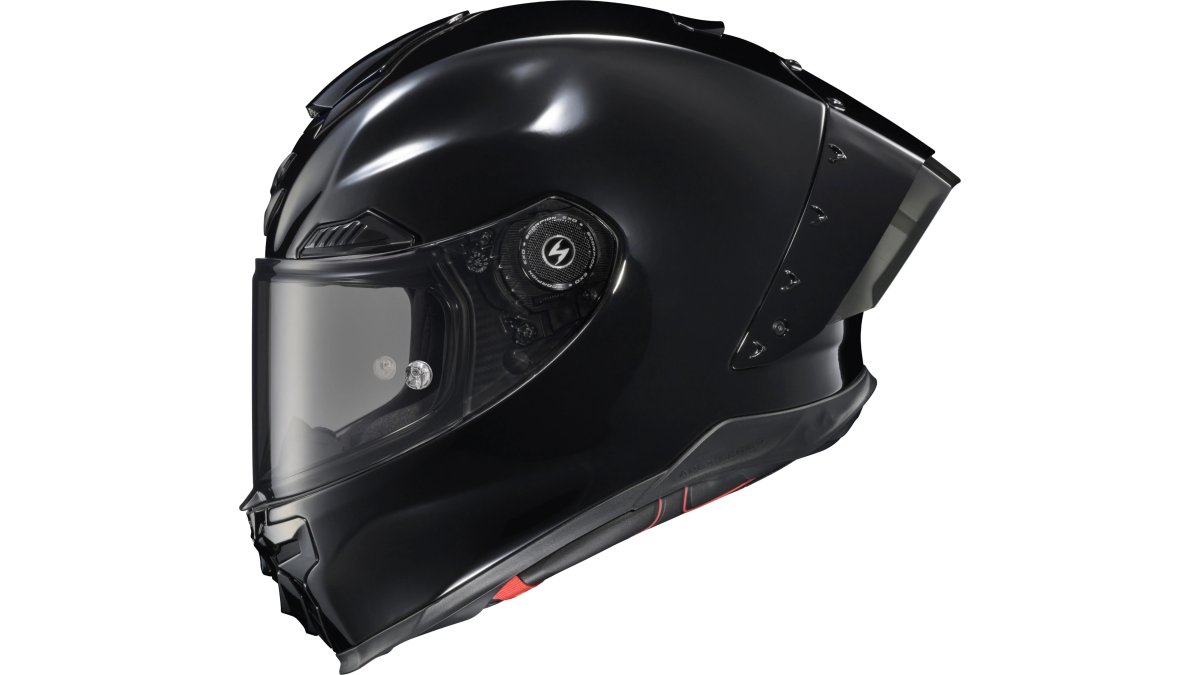
The Scorpion EXO 2026 EXO-Warp Apex addresses fit directly with an adjustable crown liner and 3D laser-cut cheek pads, and it carries triple certification: FIM Racing #2, ECE 22.06, and DOT FMVSS No. 218.
Helmet Replacement, Crash History and What the Ratings Cannot Tell You
Replace a helmet after any impact that involved your head, even if the shell looks unmarked. The energy-absorbing liner compresses to do its job, and it does not spring back. A helmet that has done its work once is spent.
Manufacturers also publish service-life guidance based on materials aging, so check the production date inside the helmet rather than assuming a helmet lasts indefinitely.
The gap between a certified helmet and a protective one is fit, condition, and honest history. We stock full-face, modular, and Bluetooth-ready helmets from Scorpion, AGV, Daytona, Shoei, Arai, and HJC, with free shipping on orders over $49 and a 30-day return policy so you can confirm the fit at home.
Frequently Asked Questions
What do DOT, ECE, Snell and FIM motorcycle helmet ratings mean?
Each is a different testing program. DOT is the self-certified federal minimum under FMVSS No. 218. ECE 22.06 is the European standard, now testing rotational impact as well as linear impact. Snell runs its own independent protocol with voluntary submission, and FIM homologation is the racing standard used in competition. A helmet can carry more than one, and the Scorpion EXO-Warp Apex carries all three of FIM Racing #2, ECE 22.06 and DOT, which tells you more than any single sticker on its own.
Is ECE or DOT better for motorcycle helmets?
ECE 22.06 is the tougher test protocol on paper because it adds rotational impact testing and a wider spread of impact points. DOT is the legal requirement for road use here, so a helmet sold for street riding needs it. The practical answer is to buy a helmet that holds both, since dual certification means the shell passed two independent test batteries. Plenty of everyday helmets do this, including the Daytona C6 modular, which is dual certified to DOT FMVSS 218 and ECE 22R06.
How can I tell if a motorcycle helmet is DOT certified?
Look inside the helmet for a DOT label in the rear of the liner, then check the manufacturer's published certification list and the model number on the box against the listing. Counterfeit shells often carry a sticker but no matching documentation, or a model name that does not exist in the brand's catalog. Buy from an authorized dealer and keep the receipt. If the price is far below every other listing for the same model, treat that as a warning rather than a bargain.
Do motorcycle helmet safety ratings account for fit?
No. Every certification test runs on a fixed headform, so a helmet can pass the lab protocol and still protect you poorly if it is the wrong shape or size for your head. Motorcycle helmet fit and safety are linked in practice: the liner has to hold the shell steady so impact energy reaches the EPS instead of sliding the helmet around. Check that the crown is snug, the cheek pads press evenly, and the chin strap sits tight under the jaw before you ride.
How often should you replace a motorcycle helmet?
Replace after any impact, even a drop from waist height, because the EPS liner compresses once and does not spring back. Without a crash, most manufacturers put the service life at about five years from first use, and you should also check the production date inside the shell before buying. A helmet that has sat on a shelf for years starts its life with less margin. Scorpion's five-year warranty on models like the EXO-R430 is a useful reference point for expected life.
Can a helmet have more than one safety certification?
Yes, and it is common among premium helmets. Dual and triple certification means the same shell passed separate protocols, which is a stronger signal than one sticker alone. The AGV Pista GP RR carries FIM, ECE 22.06 and DOT, and the Scorpion EXO-R430 is DOT FMVSS No. 218 certified with Snell 2025 approval in sizes 3X and 4X. When you compare helmets, check which certifications apply to your exact size, since some approvals are size-specific.


